

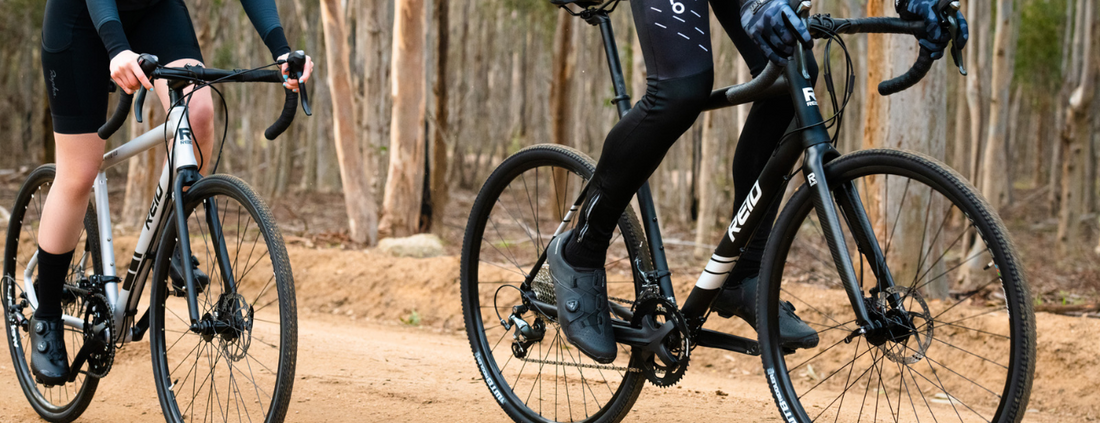
Road bikes and gravel bikes are designed for different types of riding. Road bikes are optimised for speed and efficiency on paved surfaces like bitumen roads; while Gravel bikes (like our Granite range) are designed for good performance on paved surfaces, but also off-road riding on a variety of terrain including dirt, bumpy river paths and gravel roads.
_1672282325031.png)
Here are some key differences between Road bikes and Gravel bikes:
Geometry and frame design
Road bikes have a more aggressive geometry with a shorter wheelbase and steeper angles for a more nimble ride and pedalling efficiency on sealed roads. They also have a longer reach to facilitate a lower, more aerodynamic riding position.
Gravel bikes have a longer wheelbase and slacker head angle to add stability and give more confident handling that is better suited for control over broken ground. This setup also gives improved long distance comfort over less-than-perfect surfaces. This position is also kinder on hamstrings and your lower back.
Gravel bikes usually offer far more mounting points for luggage and racks too.
Tyre clearance
Road bikes are designed to run narrow (not usually wider than 28mm), high-pressure tyres to minimise rolling resistance and increase speed. Gravel bikes have wider tyre clearance in the fork and rear stays to accommodate larger, lower-pressure tyres (35mm plus) that provide better traction and comfort on rough terrain and mud.
Drivetrain and gearing
Road bikes typically have a larger range of gears with a compact or triple crankset and a wide-range cassette, to help riders tackle steep climbs and maintain high speeds on the descent.
Gravel bikes may have a similar drivetrain but geared for better performance at lower speeds. These “granny gears” help riders navigate loose surfaces or sharp pinch climbs.
Some Gravel bikes now even have a 1x (single chainring) drivetrain with a wide-range rear cassette, which is simpler and lighter weight but may not offer as much range. A 1x setup is better for obstacle clearance, improves chain retention over rough ground, reduces the chance of damage and is simpler to operate.
Brakes
Gravel bikes are designed for use in all-conditions including dirt and mud so the brakes are usually more powerful and designed to offer better performance even when full of grit.
Overall strength
Gravel bikes are slightly heavier than their Road cousins, but this is because they offer more strength across the board. From stronger tubing, stronger welds, stronger parts in the drivetrain, bigger disc rotors in the brakes and so it goes.
_1672282352563.png)
Gravel bikes are booming in popularity as they offer the perfect mix of speed, comfort, handling and durability for any rider to jump on and tackle the toughest commute. These are do-it-all rigs that open up a wide variety of riding and are a must have in your collection if you like to get out and explore.
Check out our Granite range or visit our stores for a test ride.


